
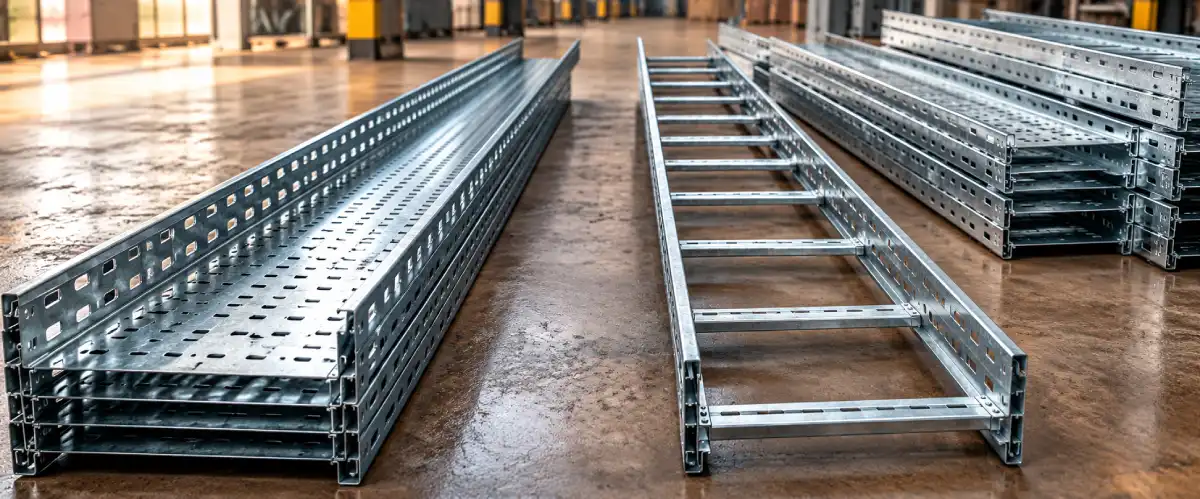
Cable management is an essential part of electrical installations in commercial buildings, industrial facilities, data centres, manufacturing plants and infrastructure projects. Where multiple power, control, communication and instrumentation cables share a route, a properly designed cable tray system helps keep them organised, accessible and adequately supported.
Selecting a cable tray involves more than choosing one that is large enough to hold the cables. Proper sizing must account for cable quantity and outside diameter, tray width and depth, cable weight, heat dissipation, support spacing, installation conditions, future expansion and applicable electrical standards.
Correctly sized cable trays provide adequate space for cable routing, support and maintenance. An undersized or overloaded system can make installation and servicing more difficult, while poor design may also limit future expansion.
What Is Cable Tray Sizing?
Cable tray sizing is the process of selecting suitable tray dimensions and load capacity to accommodate the required cables safely and efficiently. The selection must account for cable quantity and outside diameter, cable arrangement, applicable fill or spacing requirements, total cable weight, support span, installation conditions and provision for future expansion.
Key factors to consider include:
- Cable quantity and outside diameter
- Tray width and usable depth
- Cable type, voltage and intended arrangement
- Applicable fill, spacing and cable-separation requirements
- Total cable weight per unit length
- Tray load rating and support span
- Ambient temperature, cable grouping and ventilation
- Installation environment and accessibility
- Applicable electrical standards and project specifications
- Anticipated future cable requirements
A tray may have sufficient physical space for the cables but still be unsuitable if its load rating, support arrangement or installation conditions are inadequate. Both space and mechanical loading must therefore be considered.
How to Determine the Right Cable Tray Size
Selecting the right cable tray involves more than estimating the number of cables to be installed. The following factors should be evaluated during the design stage:
1. Cable quantity and dimensions: Identify the number and outside diameter of the cables, along with their intended arrangement within the tray.
2. Tray width and depth: Select dimensions that accommodate the cable layout while meeting applicable fill, spacing and separation requirements.
3. Cable loading: Calculate the total cable weight per unit length and verify that the tray’s load rating is suitable for the proposed support span and installation conditions.
4. Cable grouping and heat dissipation: Consider cable type, grouping, ambient temperature and ventilation when assessing permissible cable loading and current-carrying capacity.
5. Installation environment: Account for environmental exposure, required cable protection, accessibility and the physical conditions along the route.
6. Future expansion: Allow for anticipated additional cables where justified by the project requirements.
The final selection should be verified against applicable electrical standards, manufacturer load data, support arrangements and project specifications.
Why Proper Cable Tray Sizing Matters
1. Better Cable Organisation
The right tray size helps keep cables arranged neatly rather than crowded into a restricted space. Power, control, instrumentation and communication cables can be routed according to the installation plan and any required separation. A well-organised layout also makes cable identification, inspection and maintenance easier.
2. Improved Heat Management
Electrical cables generate heat during operation. Cable grouping, ambient temperature, installation conditions and ventilation can affect how effectively that heat is dissipated. Ladder and ventilated trays can promote airflow around cables, but tray dimensions alone do not determine the current-carrying capacity (ampacity) of the cables.
Ampacity also depends on factors such as cable construction, conductor size, ambient temperature, grouping and applicable electrical standards. The actual installation conditions must be considered when determining permissible cable loading.
3. Easier Installation
An undersized cable tray can make installation difficult, restrict proper cable arrangement and complicate routing, securing and identification. Selecting an appropriately sized tray helps installers follow the planned cable layout and carry out installation more efficiently, particularly on projects with many cable runs.
4. Easier Maintenance and Troubleshooting
Maintenance teams may need to trace circuits, inspect cable insulation, replace damaged cables or modify connections. If a tray is overcrowded, accessing an individual cable can become time-consuming and may require moving other cables. Adequate space and a clear layout make inspection and maintenance more manageable.
5. Room for Future Expansion
Electrical installations may need to accommodate additional equipment, machinery, panels and circuits over time. Planning for future cable requirements during the design stage can reduce the likelihood of costly modifications or additional tray runs.
Any spare capacity should be determined according to project requirements, applicable standards and the intended expansion plan rather than by applying one assumed allowance to every installation.
Why Cable Tray Design Should Be Planned Early
Cable tray sizing is an important part of electrical infrastructure design. A suitable system must provide adequate space for the intended cable arrangement, appropriate mechanical load capacity, suitable thermal conditions and practical access for installation and maintenance.
Sizing should be treated as an engineering design task, not merely a question of available space. Cable quantity and dimensions, cable weight, support span, grouping, ventilation, separation requirements, environmental conditions, future needs and applicable standards all influence the final selection.
Jacinth Engineering offers cable tray solutions for a range of cable management requirements. Choosing the right system at the design stage can help create installations that are organised, maintainable and adaptable to changing needs.
To explore the different cable tray types and their applications, read our related article: “Different Types of Cable Trays and How to Choose the Right One for Your Facility.”