
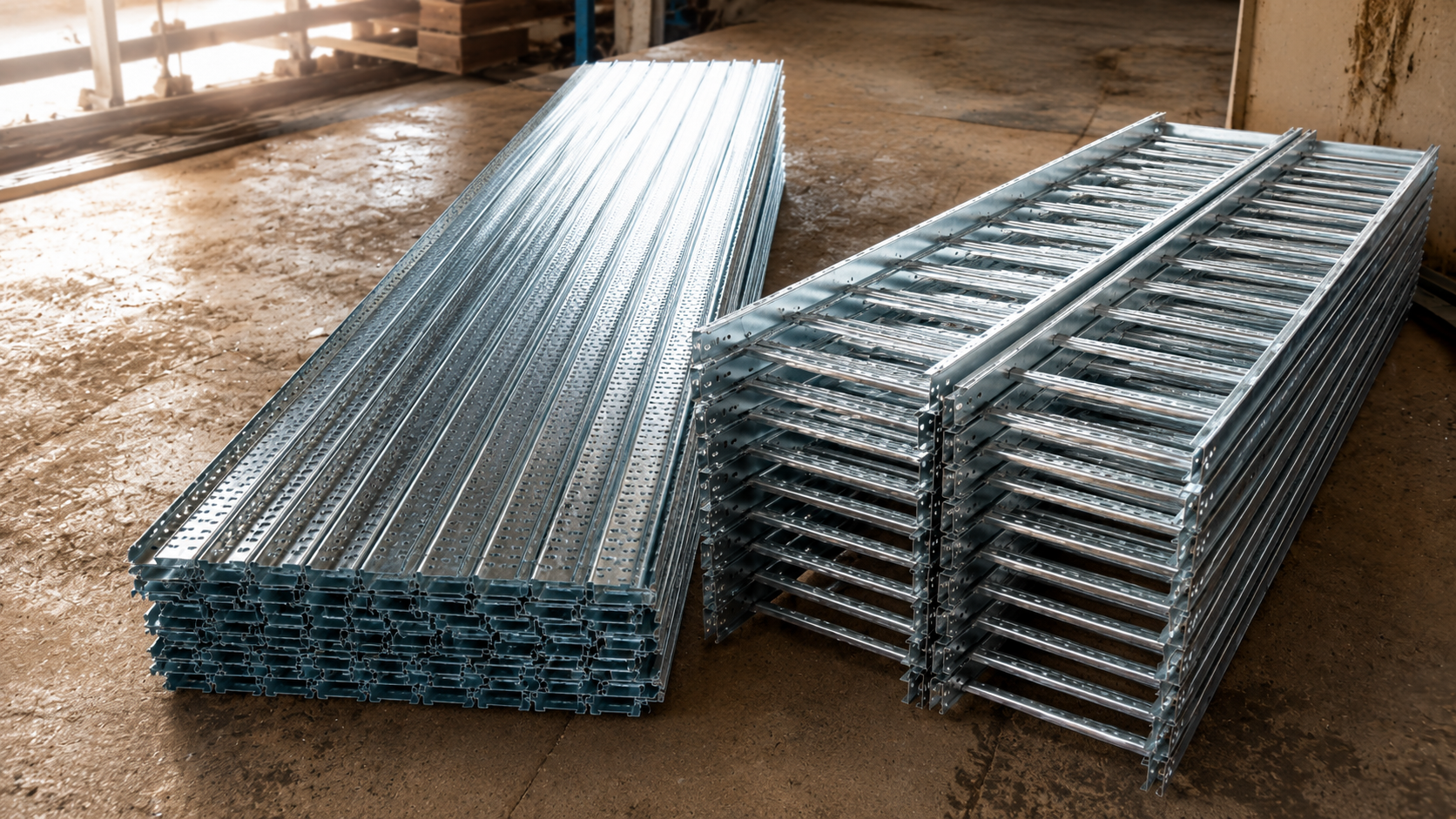
When planning an electrical installation, cables often receive all the attention, while the cable tray system is treated as an afterthought. In reality, the tray supporting those cables plays an equally important role in ensuring safety, accessibility, reliability and long-term performance.
Whether you’re designing a manufacturing plant, commercial building, data centre or infrastructure project, selecting the right cable tray can reduce maintenance costs, improve ventilation and simplify future expansion.
This guide explains the most common cable tray systems and where each performs best.
What Is a Cable Tray?
A cable tray is a structural support system designed to carry power, control and communication cables safely throughout a building or industrial facility.
Unlike closed conduits that completely enclose cables, cable trays provide an organised pathway that allows cables to be installed, inspected, modified and maintained with relative ease.
They are widely used in:
-
Manufacturing plants
-
Power generation facilities
-
Commercial buildings
-
Oil & Gas installations
-
Chemical plants
-
Data centres
-
Infrastructure projects
-
Hospitals and institutional buildings
1. Ladder Cable Tray
The ladder cable tray is the most widely used cable management system in heavy industrial applications.
Its two side rails connected by transverse rungs provide excellent mechanical strength while allowing maximum airflow around the cables. Better ventilation helps dissipate heat generated by heavily loaded power cables.
Best suited for:
-
Power plants
-
Steel plants
-
Cement plants
-
Petrochemical facilities
-
Heavy industrial projects
-
Long cable routes
Advantages:
-
High load carrying capacity
-
Excellent ventilation
-
Easy cable installation
-
Convenient inspection and maintenance
-
Ideal for large power cable installations
2. Perforated Cable Tray
Perforated cable trays feature a continuous base with uniformly spaced holes.
This design offers greater support for cables while still allowing sufficient ventilation and drainage. It is particularly useful where both protection and neat cable routing are important.
Best suited for:
-
Commercial buildings
-
Office complexes
-
Hospitals
-
Educational institutions
-
Industrial buildings
Advantages:
-
Better cable support
-
Improved cable organisation
-
Good airflow
-
Cleaner appearance
-
Suitable for power as well as control cables
3. Channel Cable Tray
Channel cable trays are compact systems intended for installations carrying relatively few cables.
They occupy very little space and are commonly used where only instrumentation, communication or control wiring is required.
Best suited for:
-
Instrumentation systems
-
Control panels
-
Automation projects
-
Communication networks
-
Small industrial installations
Advantages:
-
Space-saving design
-
Quick installation
-
Cost-effective for smaller cable runs
-
Easy routing in confined areas
4. Solid Bottom Cable Tray
Where cable protection is more important than ventilation, a solid bottom cable tray is often the preferred solution.
Its enclosed base shields sensitive cables from dust, moisture and external contaminants, making it ideal for clean environments.
Best suited for:
-
Data centres
-
Pharmaceutical facilities
-
Laboratories
-
Clean rooms
-
Sensitive electronic installations
Advantages:
-
Maximum cable protection
-
Reduced dust accumulation
-
Better protection from falling debris
-
Suitable for delicate communication and instrumentation cables
How to Choose the Right Cable Tray
No single cable tray is suitable for every installation. The correct choice depends on several engineering considerations:
- Cable Load
Heavier power cables require trays with higher load-bearing capacity, while lighter instrumentation cables can be supported using smaller systems.
- Installation Environment
Outdoor, corrosive or dusty environments demand tray systems that can withstand challenging operating conditions.
- Ventilation Requirements
Power cables generate heat. Open tray designs such as ladder cable trays allow superior airflow and help maintain cable performance.
- Future Expansion
Facilities rarely remain unchanged. Selecting a cable tray with adequate spare capacity makes future cable additions faster and more economical.
- Maintenance Accessibility
Projects requiring regular inspection or cable modifications benefit from open tray systems that provide easy access throughout the installation.
Why Does the Right Choice Matters?
A well-designed cable tray system is more than just structural support. It contributes to:
-
Improved electrical safety
-
Better cable life
-
Easier maintenance
-
Faster installation
-
Reduced downtime
-
Lower lifecycle costs
Selecting the appropriate tray during the design stage can prevent expensive modifications later in the life of the facility.
Trusted Cable Tray Solutions from Jacinth Engineering
At Jacinth Engineering, we manufacture high-quality cable management systems designed to meet the demanding requirements of industrial, commercial and infrastructure projects.
Our range includes ladder cable trays, perforated cable trays, channel cable trays and other engineered cable support solutions, manufactured with precision to deliver durability, strength and dependable performance.
Whether you’re executing a new project or upgrading an existing facility, choosing the right cable tray system is the first step towards a safe and reliable electrical installation.